
What 72 pitching cycles reveal about NACA 0012 dynamic stall
A phase-resolved study of a harmonically pitching airfoil, connecting motion definition, long-horizon numerical behavior, aerodynamic hysteresis, and coherent vortex shedding.
00 / Context
The engineering question
A pitching airfoil does not follow the steady lift curve. Separation, vortex convection, and reattachment introduce phase lag, so the same angle of attack can produce different loads on the upstroke and downstroke. The useful question is not simply where static stall occurs, but whether the simulation resolves a repeatable unsteady cycle and the flow structures responsible for it.
Can the workflow sustain a long periodic run and expose the dynamic-stall events that govern the load loop?
- pitching cycles represented
- 72.2
- phase-resolved flow frames
- 852
- computational-domain extent
- finest near-airfoil spacing
01 / Define the motion before interpreting the loads
A forced pitch cycle spanning attached flow to deep stall
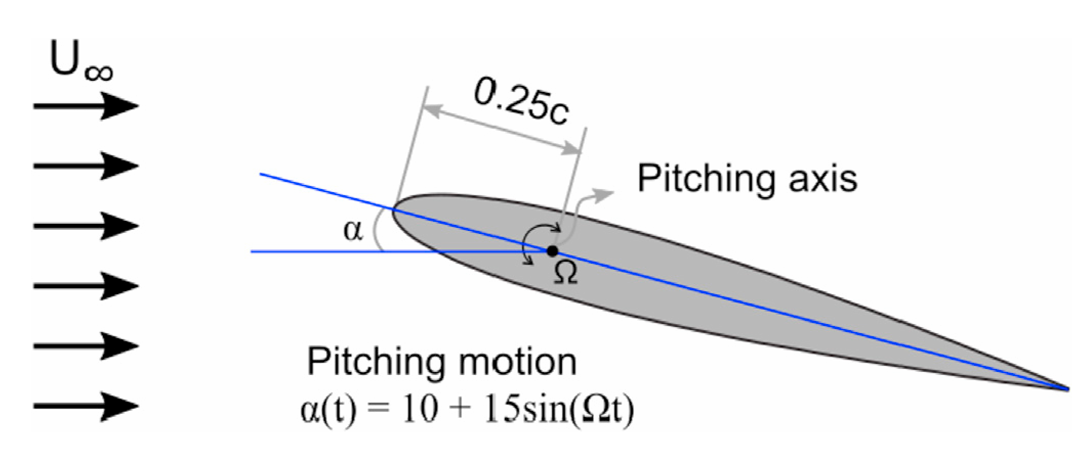
The airfoil pitches about the quarter-chord point with a mean angle and amplitude . The resulting range crosses the linear regime, stall onset, and deep-stall region during every cycle. A circular sliding region isolates the moving airfoil from the stationary outer domain.
- Motion
- Pivot
- Freestream
- Reynolds numbers
- and comparison runs
- Reported reduced frequency
- under the source convention
- Boundary layout
- Velocity inlet, pressure outlet, upper/lower symmetry
The -long outer domain places the airfoil from the inlet and uses a sliding interface around the pitching body.
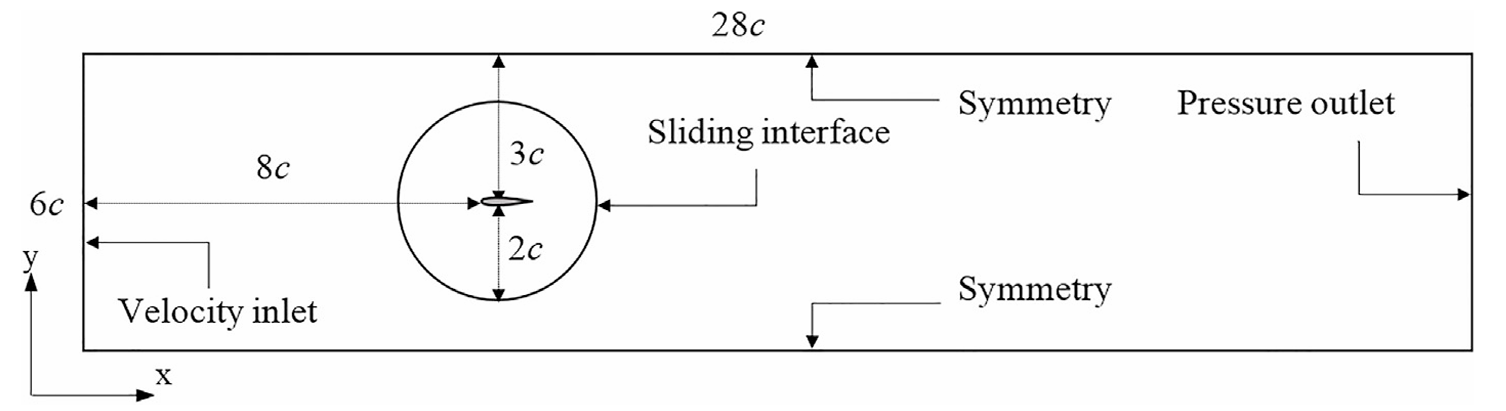
The prescribed motion rotates about and sweeps from to .
02 / See the physics that integrated coefficients hide
The wake retains the history of every pitch cycle
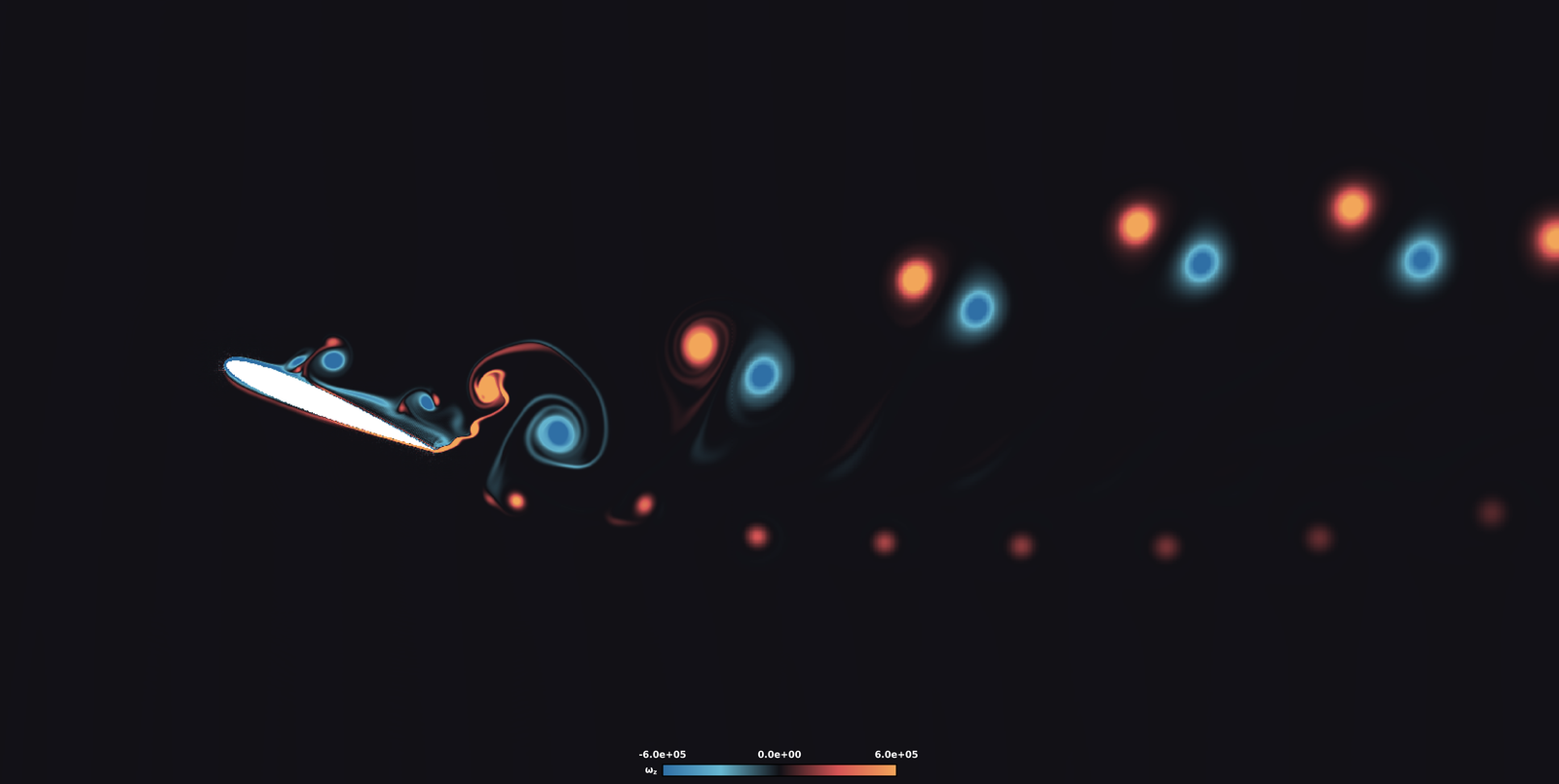
The vorticity sequence shows the near-wall shear layer rolling into coherent structures, convecting through the near wake, and organizing into an alternating vortex street. A fixed color range is used throughout so changes in apparent intensity reflect the solution rather than frame-by-frame rescaling.
Spanwise vorticity, 852 frames at 15 fps. The web version is downsampled to 1920 px while preserving the full 56.8-second sequence.
What to look for
- 01Growth and convection of the leading-edge shear-layer structure during the high-angle portion of the cycle.
- 02Alternating positive and negative wake cores that remain ordered over the long integration.
- 03No visible far-field reflection dominating the near-airfoil dynamics in the exported sequence.
03 / Test periodicity before trusting peak values
Repeatable cycles produce a stable hysteresis envelope
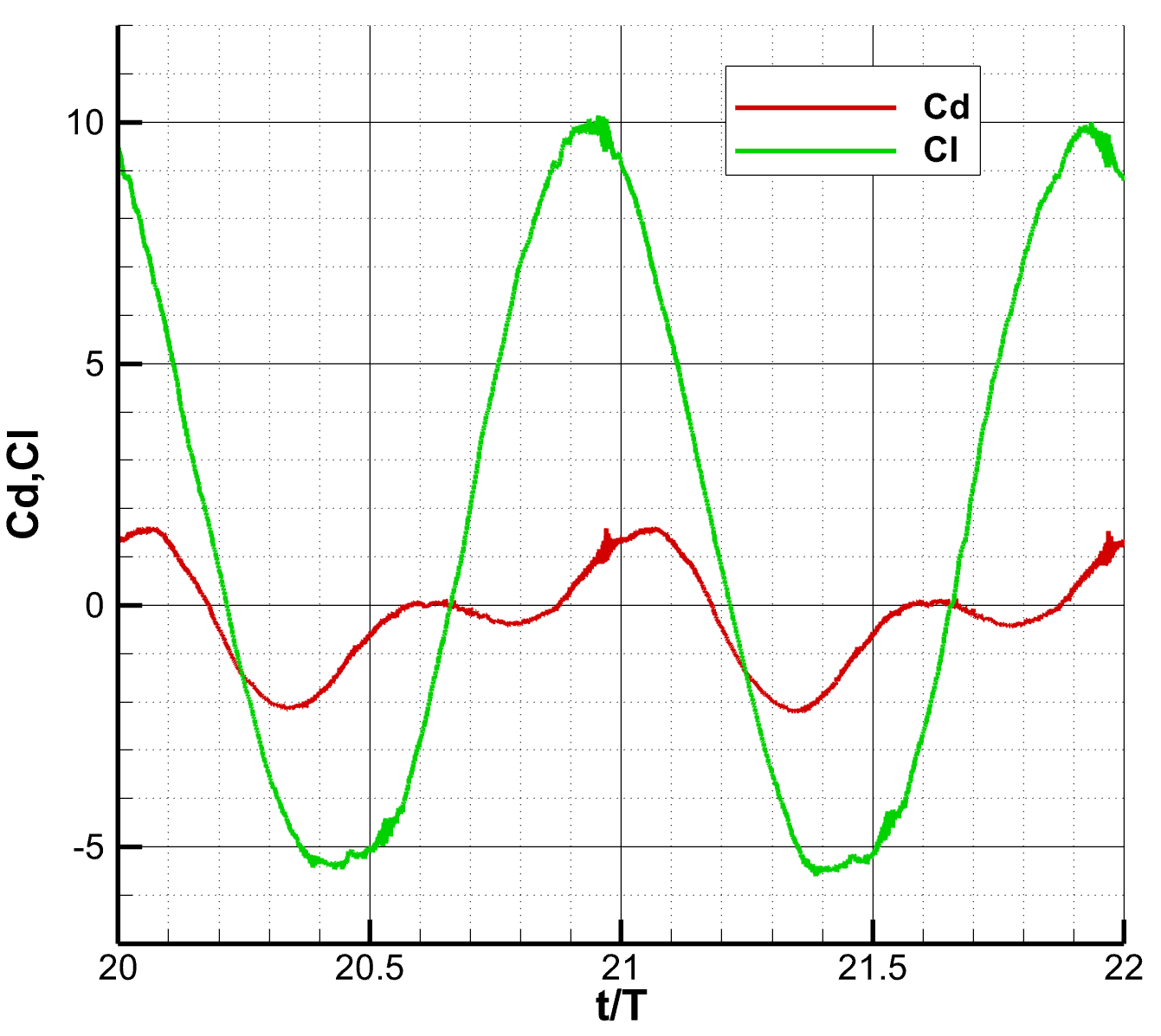
The late-time window shows two closely repeating cycles. Lift follows a strong periodic response while drag contains secondary features associated with separated-flow events. Plotting the same data against angle of attack converts phase lag into a loop: upstroke and downstroke no longer collapse onto a single steady curve.
Late-time load history over , used to inspect cycle-to-cycle repeatability.
Twenty overlaid cycles form persistent – and – envelopes rather than single-valued steady relationships.
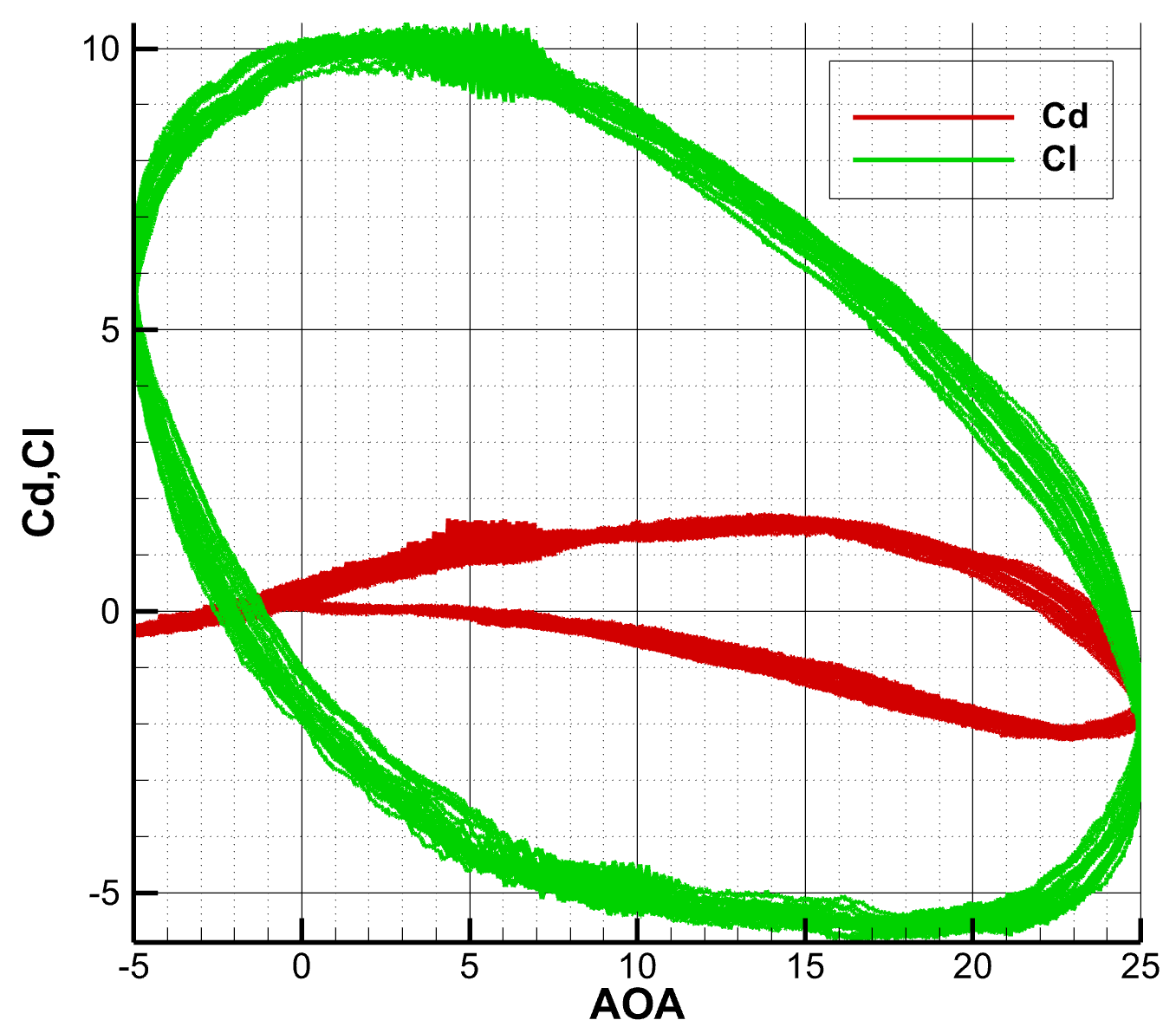
Engineering lesson: periodic-looking time histories are necessary but not sufficient. Acceptance should combine cycle overlap, mesh and time-step sensitivity, and a consistent force-coefficient convention.
04 / Establish a common basis for comparison
Compare cases only after aligning reference quantities
A useful comparison must match the force normalization, reference length and phase convention before interpreting differences in load magnitude or startup duration. For restart checks, align the motion phase and compare the developed cycles rather than isolated early peaks. For different Reynolds numbers, compare the loop shape and separation timing alongside peak values; a visually similar response alone does not establish the same numerical accuracy.
Validation note
The source slides use more than one reference-length and dynamic-pressure convention, producing coefficient magnitudes that should not be compared directly across every figure. Before publishing a quantitative validation claim, recompute all force coefficients from a single definition and repeat the mesh/time-step comparison.
05 / What the study establishes
Three defensible conclusions
01
Long-horizon stability
The exported sequence covers more than 72 cycles without visible drift or breakdown of the organized wake.
02
Phase-dependent aerodynamics
The load envelope and flow field both show that upstroke and downstroke behavior cannot be represented by one steady curve.
03
A clear next validation step
The strongest next move is to unify coefficient normalization, then quantify mesh, time-step, and literature agreement.
Study basis
Prepared from the internal NACA 0012 pitching-motion report and its extracted figures. The computational layout follows the study configuration attributed in the report to Geng et al. (2018).
Need to resolve an unsteady aerodynamic decision?
Turn transient flow into an engineering recommendation.
We can structure the motion definition, convergence evidence, phase-resolved outputs, and decision metrics around your geometry and operating envelope.